The Friction War: How Coated Abrasives Fight Thermal Clogging
Why Anti-Static Coatings Save Your Sanding Belts and Budget
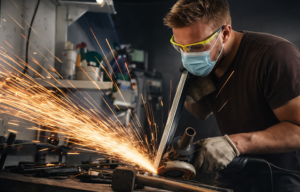
In the grit-and-grind world of surface finishing, heat is the ultimate saboteur. You’ve likely felt that creeping warmth on a workpiece—the moment when a fresh Abrasive Paper sheet suddenly stops biting and starts smearing. It’s frustrating, isn’t it? Actually, what’s happening at a microscopic level is a form of thermal suicide. As friction spikes, the resin bond softens, and the swarf—those tiny metallic or lacquer particles—fuses into the valleys between the grains. This isn’t just a loss of efficiency; it’s a total failure of the tool. In the industry, we call this “clogging” or “loading,” and frankly, it’s the primary reason most factories burn through their overhead faster than they should.
Actually, the difference between a mid-tier shop and a high-precision facility often comes down to how they manage this invisible friction. Have you ever wondered why some Sanding Belts seem to glide for hours while others choke up in minutes? The secret lies in the “recessive coating,” a specialized chemical layer that most people never even notice. It’s like the non-stick coating on a high-end chef’s pan; you can’t see it working, but you’d certainly notice if it were gone. When we engineer Coated Abrasives, we aren’t just gluing rocks to paper; we are managing a complex thermodynamic event.
The Chemistry of Non-Stick Surface Solutions in Sanding Discs
Stearates and the Magic Behind Dry Wet Sandpaper Longevity
So, how does this coating actually work? In most high-performance Sanding Discs, we integrate a layer of zinc stearate or a similar lubricant. Think of it as a sacrificial shield. As the abrasive cuts, the coating wears away slowly, creating a low-friction interface that prevents the “sticky” swarf from gaining a foothold. It’s a bit like trying to grip a wet bar of soap—the particles simply can’t latch onto the grit. This is particularly vital when you’re working with “gummy” materials like soft aluminum, resinous pine, or automotive primers.
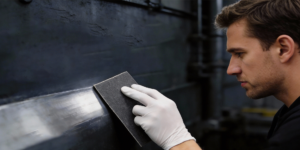
In many cases, choosing between Dry Wet Sandpaper options becomes a matter of managing this debris. While wet sanding uses water to flush the “gunk” away, dry sanding relies entirely on the chemistry of the coating. If that coating fails, the friction generates enough heat to melt the very lacquer you’re trying to smooth. Actually, I’ve seen operators push their machines harder to compensate for a clogged disc, which only accelerates the damage. It’s a vicious cycle. Wouldn’t it be better to let the chemistry do the heavy lifting? By maintaining a cool cutting zone, the lubricant ensures the grains stay sharp and exposed, rather than buried under a layer of melted waste.
From Sandpaper Roll to Precision Finish: The Anti-Static Edge
Eliminating Dust Attraction to Extend Coated Abrasives Life
There’s another culprit in the clogging mystery: static electricity. As a Sandpaper Roll spins at high RPMs, the constant friction creates a massive static charge. This charge acts like a magnet, pulling fine dust back onto the surface of the abrasive and deep into the fibers of the backing. If you’ve ever seen dust “clinging” to a workpiece despite a high-powered vacuum system, you’re witnessing static in action. This is where high-end Coated Abrasives differentiate themselves. By adding anti-static agents to the size coat, we allow the dust to remain “free” so the extraction system can actually do its job.
Say, have you noticed how some premium Abrasive Paper feels almost slippery to the touch? That’s not a defect; it’s a deliberate design choice. In most scenarios, an anti-static treatment can double the usable life of a belt or sheet. When the dust doesn’t stick, the abrasive stays cool. When it stays cool, the resin doesn’t soften. It’s a cascading benefit that affects everything from the Ra value of the finish to the electricity bill of the factory. Perhaps we should stop looking at sandpaper as a disposable scrap and start viewing it as a high-tech filter for surface imperfections.
Rethinking the Shop Floor: Scaling with Sanding Belts and Efficiency
Why Intelligent Coating Selection Outperforms Brute Force Grinding
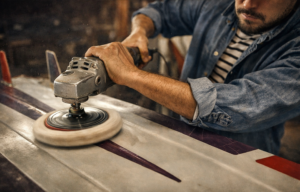
In a production environment, “brute force” is the enemy of profit. I’ve spoken with managers who complain about the cost of Sanding Belts, yet they use general-purpose products for specialized tasks like high-gloss lacquer polishing. That’s like using a sledgehammer for surgery. When you move to a Sandpaper Roll designed with a specific recessive coating, you’re not just buying a product; you’re buying time. You’re reducing the frequency of belt changes, which, in a high-volume line, can save dozens of man-hours a week.
Actually, the transition from “good enough” to “precision” grinding requires a bit of a mindset shift. We often focus on the grit size—P180, P400, P800—but we forget about the “functional life” of those grains. A P400 sheet that clogs in thirty seconds is effectively useless. On the other hand, a sheet of Dry Wet Sandpaper with a robust anti-clogging layer might maintain its P400 cutting profile for ten minutes straight. Which one is truly cheaper? The math usually favors the tech-heavy option. In the end, the goal is a surface that looks like glass and a production line that runs like a clock. Isn’t that what we’re all after?