
Precision Grinding in the 3C Era: Mastering Surface Roughness with Advanced Abrasive Paper
Why Consistency in Coated Abrasives Defines the Modern Smartphone Aesthetic
Walk into any high-end electronics flagship store, and the first thing that hits you isn’t the processor speed—it’s the light dancing off the surgical-grade stainless steel or aerospace-aluminum frame. Achieving that mirror-like finish feels like magic, but in the workshop, it’s a relentless battle against microscopic physics. When we talk about Abrasive Paper, we aren’t just talking about grit on a backing; we are discussing the fine line between a premium product and a pile of scrap metal.
Actually, the industry often overlooks how a single rogue grain can ruin an entire production batch. I recall visiting a facility where the yield rate plummeted because they treated their Coated Abrasives as a commodity rather than a precision instrument. The truth? A $0.04 \mu m$ Ra finish doesn’t happen by accident. It requires a harmony between the mineral’s friability and the bond’s thermal stability. Have you ever wondered why two sheets of the same grit produce wildly different reflections? It usually comes down to the “over-sized grain” problem—one bully in the sandbox scratching deeper than all the rest.
Deciphering Mineral Mechanics in Sanding Discs
How Strategic Grain Selection and Sanding Belts Revolutionize Metal Polishing
Choosing the right mineral for a CNC-machined frame involves more than just picking the hardest rock available. While silicon carbide offers that sharp, initial bite perfect for aluminum, it can be too brittle for the high-pressure demands of stainless steel. In most cases, we lean toward high-purity alumina or even ceramic blends. These minerals possess a “self-sharpening” quality—they fracture under stress to reveal new, sharp edges instead of dulling down and generating heat.
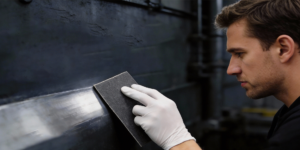
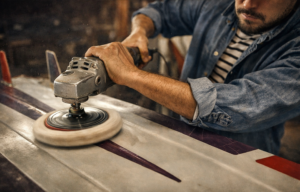
When operators switch to Sanding Discs for the final buffing stages, the backing’s flexibility becomes the secret sauce. A stiff backing might seem efficient, but it lacks the “give” needed to contour around those subtle, ergonomic curves of a modern phone. Imagine trying to wrap a stiff board around a tennis ball; it just doesn’t work. We need the abrasive to “hug” the metal. This is where the interface layer plays its part, dampening the vibration and ensuring that the Sanding Belts used in the primary grinding phase don’t leave deep, rhythmic gouges that the polishing stage can’t erase.
The Invisible Enemy: Thermal Loading and Dry Wet Sandpaper
Combatting Clogging with Advanced Coatings in Sandpaper Roll Applications
Heat is the silent killer of surface quality. As the abrasive rubs against the metal, friction creates localized hot spots that can soften the resin bond. Once that happens, the metal dust—or “swarf”—gets trapped. This is “loading,” and it’s a nightmare. To fight this, we integrate a “recessive coating,” a specialized zinc stearate or similar lubricant that acts like non-stick spray on a frying pan. It’s fascinating, really, how a layer you can barely see determines whether a Sandpaper Roll lasts ten minutes or an hour.
Using Dry Wet Sandpaper provides another layer of versatility. While dry sanding is faster and cleaner for initial stages, the introduction of a lubricant during wet sanding flushes away debris and keeps the temperature stable. Think of it as the difference between sliding your hand across a dry table versus a soapy one—the reduction in friction is instantaneous. If you aren’t managing your swarf, you aren’t grinding; you’re just burnishing the dirt back into the metal. And who wants a “muddy” finish on a thousand-dollar device?
Engineering the Perfect Ra with Sandpaper Roll Consistency
Why Precision Manufacturing in Abrasive Paper Outperforms Traditional Methods
The leap from a “smooth” surface to a “mirror” surface is exponential, not linear. As we move into the ultra-fine grits, the distribution of particles on the Abrasive Paper must be near-perfect. We utilize electrostatic deposition to ensure every grain stands upright, sharp end facing the workpiece. If the grains lie flat, they rub instead of cut, leading to a hazy, “milky” appearance rather than a crisp reflection.
Perhaps the most critical transition occurs when moving from robotic Sanding Belts to manual touch-ups. Even with the best automation, the human eye detects flaws that machines might miss. However, if the Sandpaper Roll used by the technician doesn’t match the mechanical properties of the belts used earlier, the finish will look patchy. It’s about creating a holistic ecosystem of Coated Abrasives. Each step must hand off a predictable surface to the next. Isn’t it ironic that the most high-tech gadgets on earth still rely on the fundamental science of rubbing stones against metal?



3 Responses
A really good blog and me back again.
每天都在战争,希望2026和平.
wish you all the best